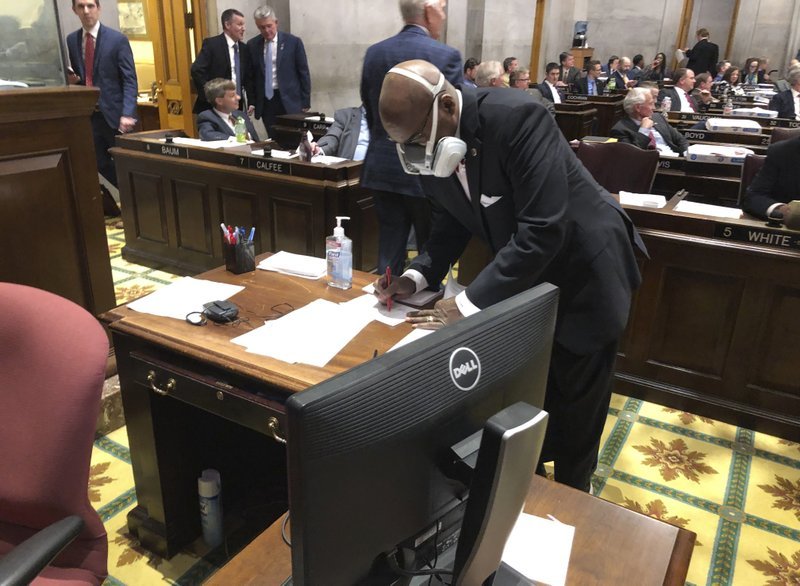
NASHVILLE, Tenn. (AP) — In close quarters advised against by health officials, Tennessee lawmakers shut down their 2020 session early after passing on Thursday a dramatically reduced spending plan for the upcoming year, in reaction to widespread coronavirus-related disruptions.
Lawmakers had been scrambling to approve a newly designed 2020-21 fiscal year budget since the beginning of the week, maintaining that only “mission critical” proposals would be passed before recessing and heading back to work as soon as June 1. Yet the GOP-dominated Statehouse faced scrutiny from open government advocates and lobbyists after closing the building to the general public.
The overhauled $39.8 billion spending plan is a far cry than what Republican Gov. Bill Lee originally proposed earlier this year — back when revenue projections were strong and confidence in the economy remained high.
Gone are Lee’s hefty investments in school literacy initiatives, teacher salaries and a proposed K-12 mental health trust fund. Instead, there’s now a $150 million fund “to help us be responsive to health and safety issues resulting from COVID-19,” as well as plan to increase the state’s rainy day fund from $875 million currently to $1.45 billion by 2021.
“This budget is nowhere near what we expected, it does at least address the principal functions of government and provides for resources that the executive branch and the governor can use to deal with the most distressed areas that we have experienced in our state,” said Republican Sen. Bo Watson, chairman of the Senate’s finance committee. “This will not solve our problems, but it’s a good first step.”
The Tennessee Emergency Management Agency’s disaster relief fund will see an additional $30 million because of not only the coronavirus, but also the fatal tornadoes that ripped across the state earlier this month.
Teacher pay raises were cut from 4% to 2% and a $250 million mental health trust fund for K-12 students was eliminated. However, the budget contains Lee’s approximately $40 million education voucher program in Nashville and Memphis’ Shelby County.
The inclusion of voucher money rather than more funding for teacher pay or the coronavirus response sparked criticism from Democrats.
Along with the budget, lawmakers eased requirements for schools choosing to close amid the virus outbreak. Yet an attempt to tweak the state’s open meeting law to allow officials to meet electronically, rather than in person, during the pandemic was spiked after the Senate and House failed to agree on a compromise.
Another measure that made it through the Statehouse would allow the use of voting “super sites” if some polling places aren’t usable during emergencies, largely in response to the tornadoes.
Lawmakers also worked on measures to help boost revenue for the state, including passing a bill designed to raise money for local 911 systems that will increase the surcharge on cellphone bills.
The bill would bump the fee from $1.16 a month to $1.50 a month starting in 2021, increasing state revenue by $12 million the first year and $25 million in the year following.
Lawmakers adjourned with the goal of returning June 1 to pick up the more contentious issues, ranging from sweeping bans on abortion to allowing most people in the state to carry a firearm in public without a background check or training to expanding paid family leave for state workers.
Legislative leaders have acknowledged that there is no guarantee that health concerns sparked by the virus outbreak would be calmer by June 1. On Thursday, a few lawmakers sat in the gallery to keep their space.
For most people, the coronavirus causes only mild or moderate symptoms, such as fever and cough. For some, especially older adults and people with existing health problems, it can cause more severe illness, including pneumonia.
The vast majority of people recover from the new virus. According to the World Health Organization, people with mild illness recover in about two weeks, while those with more severe illness may take three to six weeks to recover.
Tennessee had 150 confirmed cases as of Thursday, most of them in Middle Tennessee.